您现在的位置是:首页 >技术教程 >PyTorch 源码学习:从 Tensor 到 Storage网站首页技术教程
PyTorch 源码学习:从 Tensor 到 Storage
分享自己在学习 PyTorch 源码时阅读过的资料。本文重点关注 PyTorch 的核心数据结构 Tensor 的设计与实现。因为 PyTorch 不同版本的源码实现有所不同,所以笔者在整理资料时尽可能按版本号升序,版本号见标题前[]。最新版本的源码实现还请查看 PyTorch 仓库。更多内容请参考:
文章目录
- 通过类图理解 Tensor 的设计
- 更多关于 c10::intrusive_ptr_target、TensorImpl 和 StorageImpl 的分析
- 自顶向下探索 Tensor 的实现及内存分配
- aten/src/ATen/CheckpointTensorImpl.cpp
- aten/src/ATen/CheckpointTensorImpl.h
- aten/src/ATen/templates/TensorBody.h
- c10/core/TensorImpl.h
- c10/core/TensorImpl.cpp
- c10/core/Storage.h
- c10/core/StorageImpl.h
- c10/core/Allocator.h
- c10/util/UniqueVoidPtr.h
- c10/cuda/CUDACachingAllocator.h
- c10/cuda/CUDACachingAllocator.cpp
- 待更新……
通过类图理解 Tensor 的设计
下图来源自:[1.0.0] PyTorch的Tensor(上),当作一个简版的类图。该博客写得较早,但也具有很高的参考价值,同系列的博客还有:
- 2019-01-19:PyTorch的编译系统
- 2019-02-14:PyTorch ATen代码的动态生成
- 2019-02-18:PyTorch Autograd代码的动态生成
- 2019-02-27:PyTorch的初始化
- 2019-03-06:PyTorch的Tensor(上)
- 2019-05-11:PyTorch的Tensor(中)
- 2019-06-23:PyTorch的Tensor(下)
- 2019-03-16:PyTorch的cpp代码生成
- 2019-04-22:再谈PyTorch的初始化(上)
- 2019-04-23:再谈PyTorch的初始化(中)
- 2019-04-24:再谈PyTorch的初始化(下)
- 2019-04-30:PyTorch的动态图(上)
- 2019-05-16:PyTorch的动态图(下)
#垂直表示继承,水平表示被包含,()表示为一个类
DataPtr -> StorageImpl ->  Storage ->  (TensorImpl)  ->  (Tensor)
                                             |              |
                                             v              v
                            (Tensor) ->  Variable::Impl   Variable  -> AutogradMeta -> (TensorImpl)
其中,Storage 和 StorageImpl 之间、TensorImpl 和 Tensor 之间都使用了 Bridge 设计模式。
桥接(Bridge)设计模式是一种结构型设计模式,它旨在将抽象部分与实现部分分离,以便两者可以独立地变化。这样可以使一个类的多个维度变化独立开来,从而减少类之间的耦合度。桥接模式通过使用组合而不是继承的方式来达到这个目的。
Storage和StorageImpl的桥接模式实现:
- 抽象部分(Abstraction):这里是
Storage类。它提供了一个高级别的接口来操作和管理数据存储,但不直接实现存储的细节。- 实现部分(Implementor):这里是
StorageImpl类。它定义了存储的具体实现细节,包括数据类型、数据指针、元素数量等。- 组合关系:
Storage中包含一个指向StorageImpl的智能指针c10::intrusive_ptr<StorageImpl>。这意味着Storage并不直接实现数据存储,而是依赖StorageImpl来实现。storage_impl_是桥接接口(即实现部分)的一个实例,Storage通过它来操作实际的数据存储。使用桥接模式有以下几个好处:
- 分离接口和实现:通过将存储的接口(
Storage)与存储的实现(StorageImpl)分离,允许两者独立变化。例如,可以改变存储实现的细节而不影响存储接口,反之亦然。- 提高灵活性和可扩展性:可以很容易地添加新的存储实现而不改变现有的存储接口。同样,可以扩展存储接口而不改变存储实现。
- 减少耦合度:接口和实现之间的低耦合度提高了代码的可维护性和可测试性。
下图来源自:[1.10.0] [Pytorch 源码阅读] —— Tensor C++相关实现
- 文中有更多关于
c10::intrusive_ptr_target类、TensorImpl类和StorageImpl类源码分析的内容。
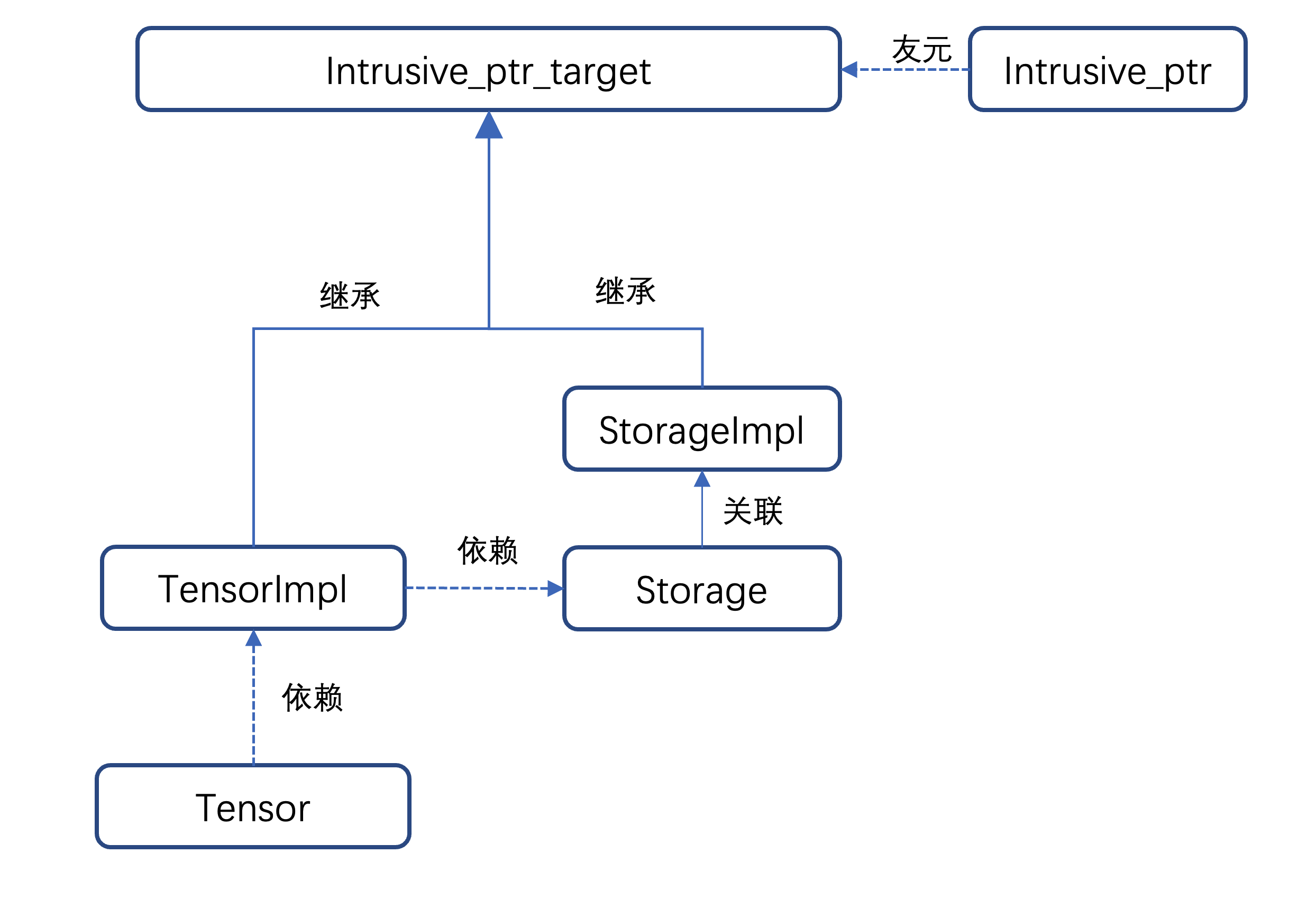
c10::intrusive_ptr的初始化需要intrusive_ptr_target或者其子类。TensorImpl和StorageImpl两个类分别为intrusive_ptr_target的子类,- 然后
StorageImpl主要负责 tensor 的实际物理内存相关的操作,设置空间配置器,获取数据指针,以及占用物理空间大小等; Storage仅仅是对StorageImpl直接包了一下,直接调用的是StorageImpl的相关成员函数。TensorImpl是Tensor类实现的主要依赖类,其初始化就需要依赖Storage类,- 所以上面说:
Tensor=TensorImpl+StorgaeImpl。
下图来源自:[2.0.0] Tensor的组织结构
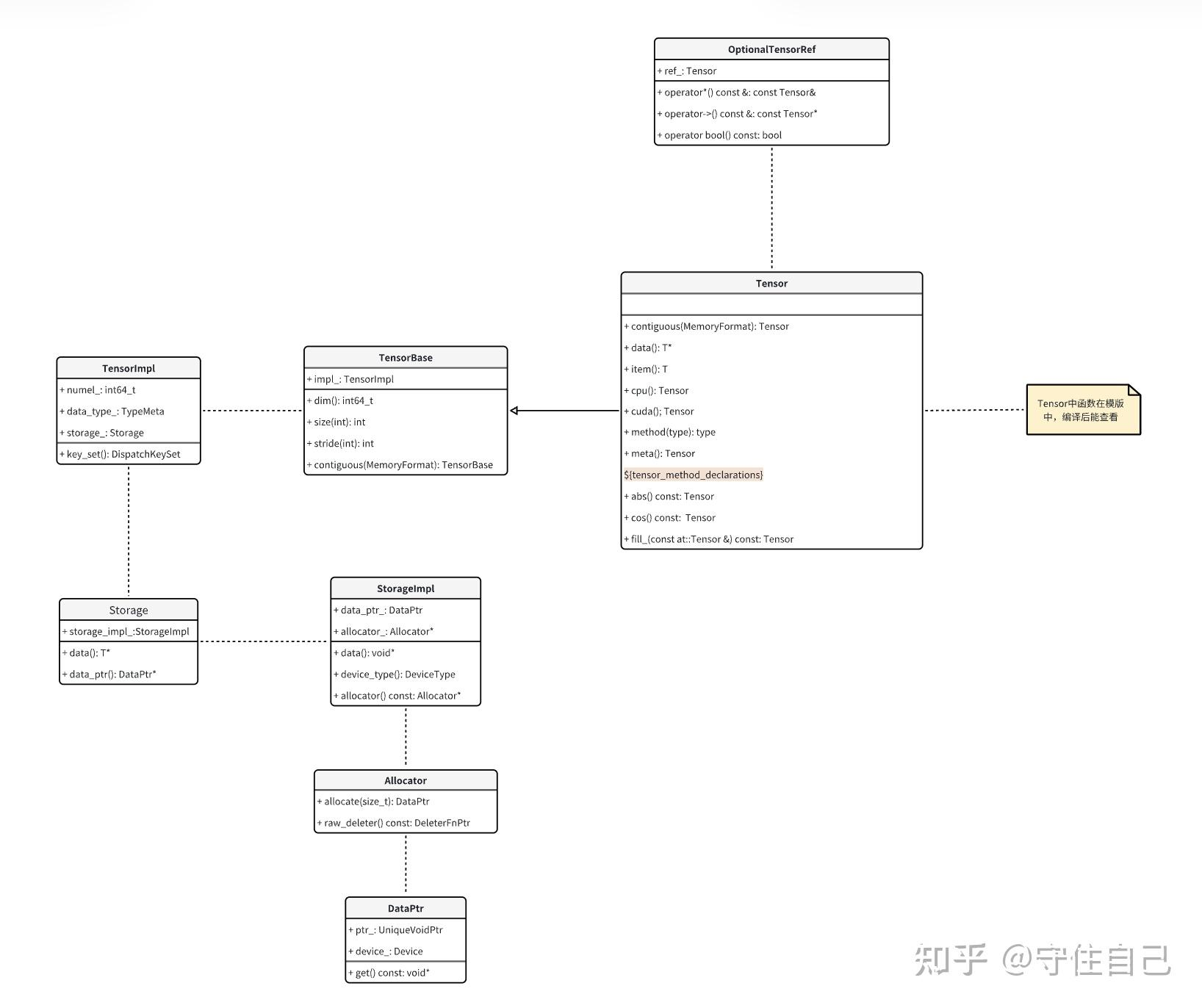
下图来源自:[unknown] pytorch源码学习-Tensor-01
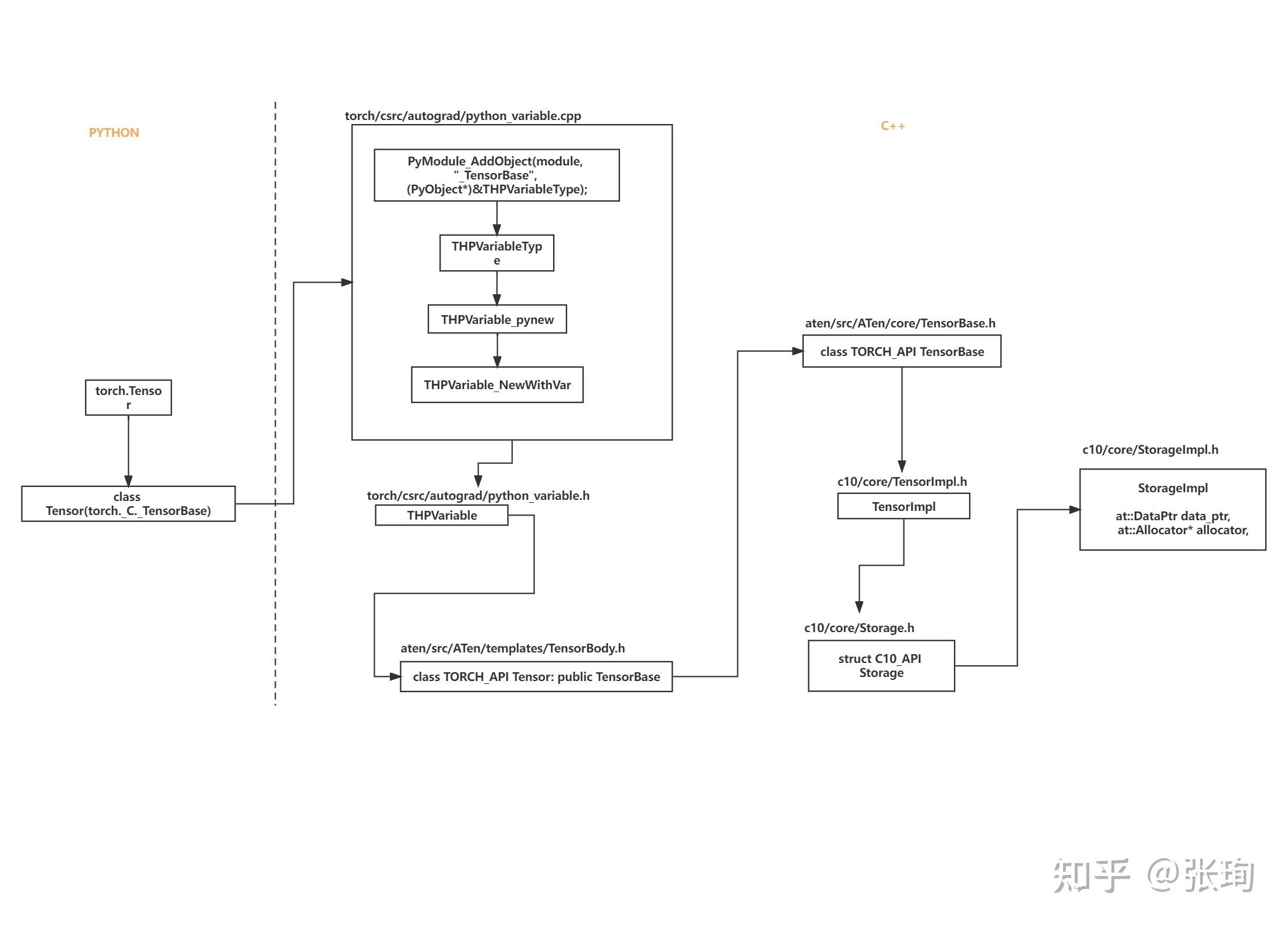
下图来源自:[unknown] Pytorch Tensor/TensorImpl/Storage/StorageImpl,及相关内容:

- Tensor, WeakTensor ->
aten/src/ATen/core/Tensor.h - TensorImpl ->
c10/core/TensorImpl.h - Storage ->
c10/core/Storage.h - StorageImpl ->
c10/core/StorageImpl.h - DataPtr, Allocator,AllocatorRegisterer ->
c10/core/Allocator.h - UniqueVoidPtr ->
c10/util/UniqueVoidPtr.h
更多关于 c10::intrusive_ptr_target、TensorImpl 和 StorageImpl 的分析
- Tensor源码分析与复现(1)& Tensor源码分析与复现(2)★★★
- 【翻译】PyTorch中的intrusive_ptr
- pytorch基于intrusive_ptr_target实现的核心数据结构介绍
自顶向下探索 Tensor 的实现及内存分配
下面的内容源于笔者读研期间的课题研究。代码可以参考 DTR 版本的 PyTorch 1.7.0。
从 CheckpointTensorImpl.cpp 里的 memory 函数开始探索
aten/src/ATen/CheckpointTensorImpl.cpp
#include <ATen/CheckpointTensorImpl.h>        ->    aten/src/ATen/CheckpointTensorImpl.h
#include <ATen/Logger.h>
#include <c10/cuda/CUDACachingAllocator.h>    ->    c10/cuda/CUDACachingAllocator.h

inline size_t memory(const Tensor& t) {
  if (! t.has_storage()) {
    return 0;
  }
  auto& storage = t.storage();
  size_t res = storage.nbytes();
  memory_sum += res;
  memory_max = std::max(memory_max, res);
  memory_count += 1;
  return res;
}

long current_memory() {
  auto device_stat = c10::cuda::CUDACachingAllocator::getDeviceStats(0);
  return device_stat.allocated_bytes[0].current;
}
aten/src/ATen/CheckpointTensorImpl.h
#include <c10/core/Backend.h>
#include <c10/core/MemoryFormat.h>
#include <c10/core/Storage.h>           ->    c10/core/Storage.h
#include <c10/core/TensorOptions.h>
#include <c10/core/DispatchKeySet.h>
#include <c10/core/impl/LocalDispatchKeySet.h>
#include <c10/core/CopyBytes.h>

#include <c10/util/Exception.h>
#include <c10/util/Optional.h>
#include <c10/util/Flags.h>
#include <c10/util/Logging.h>
#include <c10/util/python_stub.h>
#include <c10/core/TensorImpl.h>        ->    c10/core/TensorImpl.h
#include <ATen/Tensor.h>     ->    aten/src/ATen/Tensor.h    ->    aten/src/ATen/templates/TensorBody.h
#include <ATen/ATen.h>                  ->    aten/src/ATen/ATen.h
aten/src/ATen/templates/TensorBody.h
#include <c10/core/Device.h>
#include <c10/core/Layout.h>
#include <c10/core/MemoryFormat.h>
#include <c10/core/QScheme.h>
#include <c10/core/Scalar.h>
#include <c10/core/ScalarType.h>
#include <c10/core/Storage.h>        ->    c10/core/Storage.h
#include <ATen/core/TensorAccessor.h>
#include <c10/core/TensorImpl.h>     ->    c10/core/TensorImpl.h
#include <c10/core/UndefinedTensorImpl.h>
#include <c10/util/Exception.h>
#include <c10/util/Deprecated.h>
#include <c10/util/Optional.h>
#include <c10/util/intrusive_ptr.h>
#include <ATen/core/DeprecatedTypePropertiesRegistry.h>
#include <ATen/core/DeprecatedTypeProperties.h>
#include <ATen/core/NamedTensor.h>
#include <ATen/core/QuantizerBase.h>
#include <torch/csrc/WindowsTorchApiMacro.h>

class CAFFE2_API Tensor {
 public:

  bool defined() const {
    return impl_;
  }
  bool has_storage() const {
    return defined() && impl_->has_storage();
  }
  const Storage& storage() const {
    return impl_->storage();
  }

  void* data_ptr() const {
    return this->unsafeGetTensorImpl()->data();
  }

  template <typename T>
  T * data_ptr() const;

protected:

  c10::intrusive_ptr<TensorImpl, UndefinedTensorImpl> impl_;
};
c10/core/TensorImpl.h
#include <c10/core/Backend.h>
#include <c10/core/MemoryFormat.h>
#include <c10/core/Storage.h>        ->    c10/core/Storage.h
#include <c10/core/TensorOptions.h>
#include <c10/core/DispatchKeySet.h>
#include <c10/core/impl/LocalDispatchKeySet.h>
#include <c10/core/CopyBytes.h>

#include <c10/util/Exception.h>
#include <c10/util/Optional.h>
#include <c10/util/Flags.h>
#include <c10/util/Logging.h>
#include <c10/util/python_stub.h>

struct C10_API TensorImpl : public c10::intrusive_ptr_target {

 public:

  /**
   * Return a reference to the sizes of this tensor.  This reference remains
   * valid as long as the tensor is live and not resized.
   */
  virtual IntArrayRef sizes() const;

  /**
   * True if this tensor has storage. See storage() for details.
   */
  virtual bool has_storage() const;

  /**
   * Return the underlying storage of a Tensor.  Multiple tensors may share
   * a single storage.  A Storage is an impoverished, Tensor-like class
   * which supports far less operations than Tensor.
   *
   * Avoid using this method if possible; try to use only Tensor APIs to perform
   * operations.
   */
  virtual const Storage& storage() const;

  /**
   * Return the size of a single element of this tensor in bytes.
   */
  size_t itemsize() const {
    TORCH_CHECK(dtype_initialized(),
        "Cannot report itemsize of Tensor that doesn't have initialized dtype "
        "(e.g., caffe2::Tensor x(CPU), prior to calling mutable_data<T>() on x)");
    return data_type_.itemsize();
  }

protected:

  Storage storage_;
};
c10/core/TensorImpl.cpp
#include <c10/core/TensorImpl.h>        ->    c10/core/TensorImpl.h

IntArrayRef TensorImpl::sizes() const {
  return sizes_;
}

bool TensorImpl::has_storage() const {
  return storage_;
}

const Storage& TensorImpl::storage() const {
  return storage_;
}
c10/core/Storage.h
#include <c10/core/StorageImpl.h>       ->    c10/core/StorageImpl.h

struct C10_API Storage {
 public:

  size_t nbytes() const {
    return storage_impl_->nbytes();
  }
  // get() use here is to get const-correctness

  void* data() const {
    return storage_impl_.get()->data();
  }

  at::DataPtr& data_ptr() {
    return storage_impl_->data_ptr();
  }

  const at::DataPtr& data_ptr() const {
    return storage_impl_->data_ptr();
  }

  at::Allocator* allocator() const {
    return storage_impl_.get()->allocator();
  }

 protected:
  c10::intrusive_ptr<StorageImpl> storage_impl_;
};
c10/core/StorageImpl.h
#include <c10/core/Allocator.h>        ->    c10/core/Allocator.h
#include <c10/core/ScalarType.h>

#include <c10/util/intrusive_ptr.h>

struct C10_API StorageImpl final : public c10::intrusive_ptr_target {
 public:

  size_t nbytes() const {
    return size_bytes_;
  }

  at::DataPtr& data_ptr() {
    return data_ptr_;
  };

  const at::DataPtr& data_ptr() const {
    return data_ptr_;
  };

  // TODO: Return const ptr eventually if possible
  void* data() {
    return data_ptr_.get();
  }

  void* data() const {
    return data_ptr_.get();
  }

  at::Allocator* allocator() {
    return allocator_;
  }

  const at::Allocator* allocator() const {
    return allocator_;
  };

 private:
  DataPtr data_ptr_;
  size_t size_bytes_;

  Allocator* allocator_;
};
c10/core/Allocator.h
#include <c10/core/Device.h>
#include <c10/util/Exception.h>
#include <c10/util/ThreadLocalDebugInfo.h>
#include <c10/util/UniqueVoidPtr.h>    ->    c10/util/UniqueVoidPtr.h

class C10_API DataPtr {
 private:
  c10::detail::UniqueVoidPtr ptr_;
  Device device_;

 public:

  void* get() const {
    return ptr_.get();
  }

};

struct C10_API Allocator {
  virtual ~Allocator() = default;

  virtual DataPtr allocate(size_t n) const = 0;

};
c10/util/UniqueVoidPtr.h
class UniqueVoidPtr {
 private:
  // Lifetime tied to ctx_
  void* data_;
  std::unique_ptr<void, DeleterFnPtr> ctx_;

 public:

  void clear() {
    ctx_ = nullptr;
    data_ = nullptr;
  }
  void* get() const {
    return data_;
  }

};
c10/cuda/CUDACachingAllocator.h
#include <c10/cuda/CUDAStream.h>
#include <c10/core/Allocator.h>        ->    c10/core/Allocator.h
#include <c10/cuda/CUDAMacros.h>
#include <c10/util/Registry.h>

namespace CUDACachingAllocator {

struct Stat {
  int64_t current = 0;
  int64_t peak = 0;
  int64_t allocated = 0;
  int64_t freed = 0;
};

enum struct StatType : uint64_t {
  AGGREGATE = 0,
  SMALL_POOL = 1,
  LARGE_POOL = 2,
  NUM_TYPES = 3  // remember to update this whenever a new stat type is added
};

typedef std::array<Stat, static_cast<size_t>(StatType::NUM_TYPES)> StatArray;

// Struct containing memory allocator summary statistics for a device.
struct DeviceStats {
  // COUNT: allocations requested by client code
  StatArray allocation;
  // COUNT: number of allocated segments from cudaMalloc().
  StatArray segment;
  // COUNT: number of active memory blocks (allocated or used by stream)
  StatArray active;
  // COUNT: number of inactive, split memory blocks (unallocated but can't be released via cudaFree)
  StatArray inactive_split;

  // SUM: bytes requested by client code
  StatArray allocated_bytes;
  // SUM: bytes reserved by this memory allocator (both free and used)
  StatArray reserved_bytes;
  // SUM: bytes within active memory blocks
  StatArray active_bytes;
  // SUM: bytes within inactive, split memory blocks
  StatArray inactive_split_bytes;

  // COUNT: total number of failed calls to CUDA malloc necessitating cache flushes.
  int64_t num_alloc_retries = 0;

  // COUNT: total number of OOMs (i.e. failed calls to CUDA after cache flush)
  int64_t num_ooms = 0;
};

// Struct containing info of an allocation block (i.e. a fractional part of a cudaMalloc)..
struct BlockInfo {
  int64_t size = 0;
  bool allocated = false;
  bool active = false;
};

// Struct containing info of a memory segment (i.e. one contiguous cudaMalloc).
struct SegmentInfo {
  int64_t device = 0;
  int64_t address = 0;
  int64_t total_size = 0;
  int64_t allocated_size = 0;
  int64_t active_size = 0;
  bool is_large = false;
  std::vector<BlockInfo> blocks;
};

C10_CUDA_API void* raw_alloc(size_t nbytes);
C10_CUDA_API void* raw_alloc_with_stream(size_t nbytes, cudaStream_t stream);
C10_CUDA_API void raw_delete(void* ptr);

C10_CUDA_API Allocator* get();
C10_CUDA_API void init(int device_count);
C10_CUDA_API void emptyCache();
C10_CUDA_API void cacheInfo(int dev_id, size_t* cachedAndFree, size_t* largestBlock);
C10_CUDA_API void* getBaseAllocation(void *ptr, size_t *size);
C10_CUDA_API void recordStream(const DataPtr&, CUDAStream stream);
C10_CUDA_API DeviceStats getDeviceStats(int device);
C10_CUDA_API void resetAccumulatedStats(int device);
C10_CUDA_API void resetPeakStats(int device);
C10_CUDA_API std::vector<SegmentInfo> snapshot();

C10_CUDA_API std::mutex* getFreeMutex();

C10_CUDA_API std::shared_ptr<void> getIpcDevPtr(std::string handle);
} // namespace CUDACachingAllocator
c10/cuda/CUDACachingAllocator.cpp
#include <c10/cuda/CUDACachingAllocator.h>    ->    c10/cuda/CUDACachingAllocator.h

#include <c10/cuda/CUDAGuard.h>
#include <c10/cuda/CUDAException.h>
#include <c10/cuda/CUDAFunctions.h>
#include <c10/util/UniqueVoidPtr.h>           ->    c10/util/UniqueVoidPtr.h
void* raw_alloc(size_t nbytes);
// 实现
void* raw_alloc(size_t nbytes) {
  if (nbytes == 0) {
    return nullptr;
  }
  int device;
  C10_CUDA_CHECK(cudaGetDevice(&device));
  void* r = nullptr;
  caching_allocator.malloc(&r, device, nbytes, cuda::getCurrentCUDAStream(device));
  return r;
}

---

/** allocates a block which is safe to use from the provided stream 从提供的流中分配一个可以安全使用的块
 * THCCachingAllocator 类的成员函数
 * 被 void* raw_alloc 调用
*/
void malloc(void** devPtr, int device, size_t size, cudaStream_t stream) {
  TORCH_INTERNAL_ASSERT(
      0 <= device && device < device_allocator.size(),
      "Allocator not initialized for device ",
      device,
      ": did you call init?");
  // 调用device_allocator的分配函数,并且把新建的block加入到add_allocated_block中。
  Block* block = device_allocator[device]->malloc(device, size, stream);
  add_allocated_block(block);
  *devPtr = (void*)block->ptr;
}

---

/**
 * 被 THCCachingAllocator 类的成员函数 void malloc 调用
 * DeviceCachingAllocator 类的成员函数
*/
Block* malloc(int device, size_t size, cudaStream_t stream)
{
  std::unique_lock<std::recursive_mutex> lock(mutex);

  // process outstanding cudaEvents
  process_events();
  // 分配512 byte倍数的数据
  size = round_size(size);
  // 寻找合适的内存池进行分配
  auto& pool = get_pool(size);
  // 根据分配segment分配分配空间
  const size_t alloc_size = get_allocation_size(size);
  // 把需要的数据放入params中,尤其是size、alloc_size
  AllocParams params(device, size, stream, &pool, alloc_size, stats);
  // 设置标志,其中stat_types包括三个标志,分别针对AGGREGATE、SMALL_POOL以及LARGE_POOL,分别有bitset进行赋值(true of false)
  params.stat_types[static_cast<size_t>(StatType::AGGREGATE)] = true;
  params.stat_types[static_cast<size_t>(get_stat_type_for_pool(pool))] = true;

  // 最为核心的部分,包括了四个小部分。
  bool block_found =
    // Search pool
    // 从对应大小的Pool中搜索出>=所需size的数据,并分配。
    get_free_block(params)
    // Trigger callbacks and retry search 手动进行一波垃圾回收,回收掉没人用的 Block,再调用 get_free_block
    || (trigger_free_memory_callbacks(params) && get_free_block(params))
    // Attempt allocate
    // Allocator 在已有的 Block 中找不出可分配的了,就调用 cudaMalloc 创建新的 Block。
    || alloc_block(params, false)
    // Free all non-split cached blocks and retry alloc. 释放所有非分割缓存块并重试分配。
    // 如果无法分配合理的空间,那么系统会调用free_cached_blocks()函数先将cache释放掉,然后再重新分配。
    || (free_cached_blocks() && alloc_block(params, true));

  // 如果无法重复使用指针,也没有额外的资源分配空间。
  // 该部分处理分配未成功的部分。如果走到了这里,那程序就意味着没救了,剩下的就只有崩溃。
  TORCH_INTERNAL_ASSERT((!block_found && params.err != cudaSuccess) || params.block);
  if (!block_found) {
    if (params.err == cudaErrorMemoryAllocation) {
      size_t device_free;
      size_t device_total;
      C10_CUDA_CHECK(cudaMemGetInfo(&device_free, &device_total));

      stats.num_ooms += 1;

      // "total capacity": total global memory on GPU
      // "already allocated": memory allocated by the program using the
      //                      caching allocator
      // "free": free memory as reported by the CUDA API
      // "cached": memory held by the allocator but not used by the program
      //
      // The "allocated" amount  does not include memory allocated outside
      // of the caching allocator, such as memory allocated by other programs
      // or memory held by the driver.
      //
      // The sum of "allocated" + "free" + "cached" may be less than the
      // total capacity due to memory held by the driver and usage by other
      // programs.
      //
      // Note that at this point free_cached_blocks has already returned all
      // possible "cached" memory to the driver. The only remaining "cached"
      // memory is split from a larger block that is partially in-use.
      TORCH_CHECK_WITH(CUDAOutOfMemoryError, false,
        "CUDA out of memory. Tried to allocate ", format_size(alloc_size),  // 使内存分配不足的最后一颗稻草。
        " (GPU ", device, "; ",
        format_size(device_total), " total capacity; ", // GPU设备的总显存大小,该值来源于cudaMemGetInfo(&device_free, &device_total),而该函数能返回gpu中的free与total显存的量。
        format_size(stats.allocated_bytes[static_cast<size_t>(StatType::AGGREGATE)].current),
        " already allocated; ", // 表示使用cache分配器已经分配的数据的量,对应malloc中的update_stat_array(stats.allocated_bytes, block->size, params.stat_types);
        format_size(device_free), " free; ",  // 为free显存的量
        format_size(stats.reserved_bytes[static_cast<size_t>(StatType::AGGREGATE)].current),
        " reserved in total by PyTorch)");  // 表示PyTorch中真正分配与cache后的数据,就是该值减去“已经分配的值(stats.allocated_bytes)”就是暂存在pool中的物理上已经分配但是逻辑上没有被使用的总显存大小。
    } else {
      C10_CUDA_CHECK(params.err);
    }
  }

  Block* block = params.block;
  Block* remaining = nullptr;
  TORCH_INTERNAL_ASSERT(block);

  const bool already_split = block->is_split();
  // block分裂,针对get_free_block以及alloc_block情况(复用cache的指针以及重新分配)
  if (should_split(block, size)) {
    remaining = block;
    // 新建一个block,其大小为size,而不是alloc_size(因为alloc_size实际大小过大,需要分裂)
    block = new Block(device, stream, size, &pool, block->ptr);
    // 在原来的block链中间插入新的block,而把原来的block转化为remaining,添加到新block的后面
    block->prev = remaining->prev;
    if (block->prev) {
      block->prev->next = block;
    }
    block->next = remaining;

    remaining->prev = block;
    remaining->ptr = static_cast<char*>(remaining->ptr) + size;
    // 将remaining块缩小
    remaining->size -= size;
    pool.insert(remaining);

    if (already_split) {
      // An already-split inactive block is being shrunk by size bytes.
      update_stat_array(stats.inactive_split_bytes, -block->size, params.stat_types);
    } else {
      // A new split inactive block is being created from a previously unsplit block,
      // size remaining->size bytes.
      update_stat_array(stats.inactive_split_bytes, remaining->size, params.stat_types);
      update_stat_array(stats.inactive_split, 1, params.stat_types);
    }
  } else if (already_split) {
    // An already-split block is becoming active
    update_stat_array(stats.inactive_split_bytes, -block->size, params.stat_types);
    update_stat_array(stats.inactive_split, -1, params.stat_types);
  }

  block->allocated = true;
  // active_blocks中存储的是正在使用的block,insert表示将新建立的block插入到这个集合中
  active_blocks.insert(block);

  c10::reportMemoryUsageToProfiler(
      block, block->size, c10::Device(c10::DeviceType::CUDA, device));

  // 以此保存内存分配次数、内存分配byte大小、正在使用的数据个数、正在使用的数据大小
  update_stat_array(stats.allocation, 1, params.stat_types);
  update_stat_array(stats.allocated_bytes, block->size, params.stat_types);
  update_stat_array(stats.active, 1, params.stat_types);
  update_stat_array(stats.active_bytes, block->size, params.stat_types);

  return block;
}

---

std::mutex mutex;

// allocated blocks by device pointer 通过设备指针分配块
// 在缓存分配器中跟踪分配的内存块。
/**
这行代码声明了一个名为 allocated_blocks 的 std::unordered_map 容器。
这个哈希表将 void* 类型的键(在本例中是设备指针,指向分配的内存)映射到 Block* 类型的值
(Block 结构体代表分配的内存块的信息)。
std::unordered_map 基于哈希表实现,提供了平均常数时间复杂度的查找、插入和删除操作。
*/
std::unordered_map<void*, Block*> allocated_blocks;

/**
 * THCCachingAllocator 类的成员函数
 * 将新分配的内存块添加到 allocated_blocks 哈希表中。
 *
 * 被 THCCachingAllocator 类的成员函数 void malloc 调用
*/
void add_allocated_block(Block* block) {
  std::lock_guard<std::mutex> lock(mutex);
  allocated_blocks[block->ptr] = block;
}
void* raw_alloc_with_stream(size_t nbytes, cudaStream_t stream);
// 实现
void* raw_alloc_with_stream(size_t nbytes, cudaStream_t stream) {
  if (nbytes == 0) {
    return nullptr;
  }
  int device;
  C10_CUDA_CHECK(cudaGetDevice(&device));
  void* r = nullptr;
  // 和 id* raw_alloc(size_t nbytes) 的实现区别在指定 stream
  caching_allocator.malloc(&r, device, nbytes, stream);
  return r;
}
raw_delete(void* ptr);
// void raw_delete(void* ptr); 的实现
void raw_delete(void* ptr) {
  caching_allocator.free(ptr);
}

---

/**
 * THCCachingAllocator 类的成员函数
 * 被 void raw_delete 调用
*/
void free(void* ptr) {
  if (!ptr) {
    return;
  }
  Block* block = get_allocated_block(ptr, true /* remove */);
  if (!block) {
    AT_ERROR("invalid device pointer: ", ptr);
  }
  device_allocator[block->device]->free(block);
}

---

/**
 * THCCachingAllocator 的成员函数
 * 被 void free 调用
*/
Block* get_allocated_block(void *ptr, bool remove=false) {
  std::lock_guard<std::mutex> lock(mutex);
  auto it = allocated_blocks.find(ptr);
  if (it == allocated_blocks.end()) {
    return nullptr;
  }
  Block* block = it->second;
  if (remove) {
    allocated_blocks.erase(it);
  }
  return block;
}

---

/**
 * 被 THCCachingAllocator 的成员函数 void free 调用
*/
void free(Block* block)
{
  std::lock_guard<std::recursive_mutex> lock(mutex);

  block->allocated = false;

  c10::reportMemoryUsageToProfiler(
      block, -block->size, c10::Device(c10::DeviceType::CUDA, block->device));
  // 更新全局的记录
  StatTypes stat_types;
  stat_types[static_cast<size_t>(StatType::AGGREGATE)] = true;
  stat_types[static_cast<size_t>(get_stat_type_for_pool(*(block->pool)))] = true;
  update_stat_array(stats.allocation, -1, {stat_types});
  update_stat_array(stats.allocated_bytes, -block->size, {stat_types});
  // 判断stream是不是空的
  if (!block->stream_uses.empty()) {
    // stream_uses不是空,则进入
    insert_events(block);
  } else {
    // 是空的进入
    free_block(block);
  }
}
void* getBaseAllocation(void *ptr, size_t *size);
// void* getBaseAllocation(void *ptr, size_t *size); 的实现
void* getBaseAllocation(void *ptr, size_t *size)
{
  return caching_allocator.getBaseAllocation(ptr, size);
}

---

// THCCachingAllocator 类的成员函数,被 void* getBaseAllocation 调用
void* getBaseAllocation(void* ptr, size_t* outSize)
{
  Block* block = get_allocated_block(ptr);
  if (!block) {
    AT_ERROR("invalid device pointer: ", ptr);
  }
  return device_allocator[block->device]->getBaseAllocation(block, outSize);
}

---

/**
 * 被 THCCachingAllocator 类的成员函数 void* getBaseAllocation 调用
*/
void* getBaseAllocation(Block* block, size_t* outSize) {
  std::lock_guard<std::recursive_mutex> lock(mutex);
  while (block->prev) { // 找到一个 segment 的头指针
    block = block->prev;
  }
  void *basePtr = block->ptr; // 找到了,暂存给 basePtr
  if (outSize) {
    size_t size = 0;
    while (block) {
      size += block->size;
      block = block->next;
    }
    *outSize = size;  // 求的应该是这个 segment 的长度
  }
  return basePtr;
}
待更新……




站长推荐
- QT多线程的5种用法,通过使用线程解决UI主界面的耗时操作代码,防止界面卡死。
 QT多线程的5种用法,通过使用线程解决UI主界面的耗时操作代码,防止界面卡死。...
 - U8W/U8W-Mini使用与常见问题解决
 U8W/U8W-Mini使用与常见问题解决
 - stm32使用HAL库配置串口中断收发数据(保姆级教程)
 stm32使用HAL库配置串口中断收发数据(保姆级教程)
 - 分享几个国内免费的ChatGPT镜像网址(亲测有效)
 分享几个国内免费的ChatGPT镜像网址(亲测有效)
 - Allegro16.6差分等长设置及走线总结
 Allegro16.6差分等长设置及走线总结