您现在的位置是:首页 >技术教程 >【Gee-Web框架】【Day3】【Golang】前缀树路由网站首页技术教程
【Gee-Web框架】【Day3】【Golang】前缀树路由
简介【Gee-Web框架】【Day3】【Golang】前缀树路由
- 使用Trie树实现动态路由解析dynamic route
- 支持两种模式:name和*filepath
一、 Trie树
1. 简要说明
- 用map结构存储路由表,使用map存储键值对,索引非常高效
- 但有一个弊端,键值对的存储方式,只能用来索引静态路由
- 如果想支持类似于/hello/:name的动态路由怎么办
- 动态路由有多种实现方式
- 实现动态路由最常用的数据结构,被称为前缀树Trie树
- 每一个节点的所有的子节点都拥有相同的前缀
- 这种结构非常适用于路由匹配
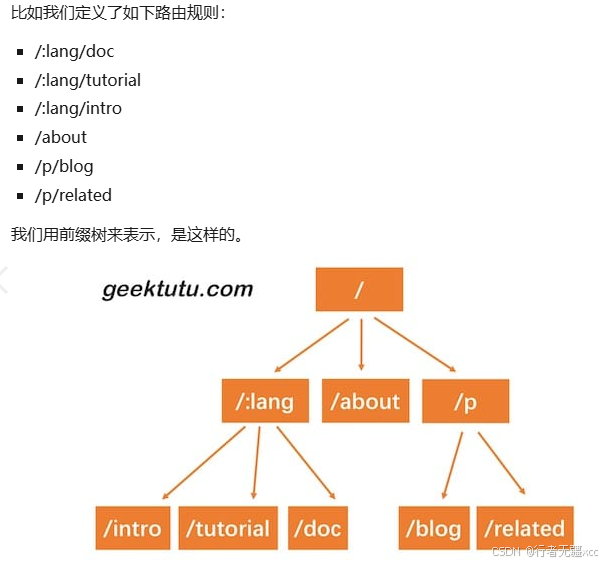
- HTTP请求的路径恰好是由/分隔的多段构成的
- 因此,每一段可以作为前缀树的一个节点
- 通过树结构查询,如果中间某一层的节点都不满足条件,那么就说明没有匹配到路由,查询结束
2. Trie树实现
- trie.go
- 与普通的树不同,为了实现动态路由匹配,加上了isWild这个参数
- 对于路由来说,最重要的是注册与匹配
- 开发服务时,注册路由规则,映射handler
- 访问时,匹配路由规则,查找对应的handler
- 因此Trie树需要支持节点的插入与查询
type node struct{
	pattern string  // 待匹配路由
	part string  // 路由中的一部分
	children []*node  // 子节点
	isWild bool  // 是否精确匹配
}

// 第一个匹配成功的节点,用于插入
func (n *node) matchChild(part string) *node{
	for _, child := range n.children{
		if child.part == part || child.isWild{
			return child
		}
	}
	return nil
}

// 所有匹配成功的节点,用于查找
func (n *node) matchChildren(part string)[]*node{
	nodes := make([]*node, 0)
	for _, child := range n.children{
		if child.part == part || child.isWild{
			nodes = append(nodes, child)
		}
	}
	return nodes
}

func (n *node) insert(pattern string, parts []string, height int){
	if len(parts) == height{
		n.pattern = pattern
		return
	}
	part := parts[height]
	child := n.matchChild(part)
	if child == nil{
		child = &node{part: part, isWild: part[0] == ":" || part[0] == "*"}
		n.children = append(n.children, child)
	}
	child.insert(pattern, parts, height+1)
}

func (n *node) search(parts []string, height int) *node{
	if len(parts) == height || strings.HasPrefix(n.part, "*"){
		if n.pattern == ""{
			return nil
		}
		return n
	}
	part := parts[height]
	children := n.matchChildren(part)
	for _, child := range children{
		result := child.search(parts, height+1)
		if result != nil{
			return result
		}
	}
	return nil
}
二、 Router
1. 简要说明
- Trie树的插入与查找都实现了,接下来将Trie树应用到路由中去
- router.go
type router struct{ roots map[string]*node handlers map[string]HandlerFunc } func newRouter() *router{ return &router{ roots: make(map[string]*node), handlers: make(map[string]HandlerFunc), } } func parsePattern(pattern string) []string{ vs := strings.Split(pattern, "/") parts := make([]string, 0) for _, item := range vs{ if item != ""{ parts = append(parts, item) if item[0] == "*"{ break } } } return parts } func (r *router) addRoute(method string, pattern string, handler HandlerFunc){ parts := parsePattern(pattern) key := method + "-" + pattern _, ok := r.roots[method] if !ok{ r.roots[method] = &node{} } r.roots[method].insert(pattern, parts, 0) r.handlers[key] = handler } func (r *router) getRoute(method string, path string)(*node, map[string]string){ searchParts := parsePattern(path) params := make(map[string]string) root, ok := r.roots[method] if !ok{ return nil, nil } n := root.search(searchParts, 0) if n != nil{ parts := parsePattern(n.pattern) for index, part := range parts{ if part[0] == ":"{ params[part[1:]] = searchParts[index] } if part[0] == "*" && len(part) > 1{ params[part[1:]] = strings.Join(searchParts[index: ], "/") break } } return n, params } return nil, nil } - context.go
type Context struct{ Writer http.ResponseWriter Req *http.Request Path string Method string Params map[string]string StatusCode int } func (c *Context) Param(key string) string{ value, _ := c.Params[key] return value } - router.go
func (r *router) handle(c *Context){ n, params := r.getRoute(c.Method, c.Path) if n != nil{ c.Parmas = params key := c.Method + "-" + n.pattern r.handlers[key](c) }else{ c.String(http.StatusNotFound, "404 NOT FOUND: %s ", c.Path) } } - main.go
func main(){
	r := gee.New()
	r.GET("/", func(c *gee.Context){
		c.HTML(http.StatusOK, "<h1>Hello Gee</h1>")
	})
	r.GET("/hello", func(c *gee.Context){
		c.String(http.StatusOK, "hello %s, you're at %s
", c.Query("name"), c.Path)
	})
	r.GET("/hello/:name", func(c *gee.Context){
		c.String(http.StatusOK, "hello %s, you're at %s
", c.Param("name"), c.Path)
	})
	r.GET("/asserts/*filepath", func(c *gee.Context){
		c.JSON(http.StatusOK, gee.H{"filepath": c.Param("filepath")})
	})
	r.Run(":9999")
}
参考
- https://geektutu.com/post/gee-day3.html
风语者!平时喜欢研究各种技术,目前在从事后端开发工作,热爱生活、热爱工作。





站长推荐
- QT多线程的5种用法,通过使用线程解决UI主界面的耗时操作代码,防止界面卡死。
 QT多线程的5种用法,通过使用线程解决UI主界面的耗时操作代码,防止界面卡死。...
 - U8W/U8W-Mini使用与常见问题解决
 U8W/U8W-Mini使用与常见问题解决
 - stm32使用HAL库配置串口中断收发数据(保姆级教程)
 stm32使用HAL库配置串口中断收发数据(保姆级教程)
 - 分享几个国内免费的ChatGPT镜像网址(亲测有效)
 分享几个国内免费的ChatGPT镜像网址(亲测有效)
 - Allegro16.6差分等长设置及走线总结
 Allegro16.6差分等长设置及走线总结